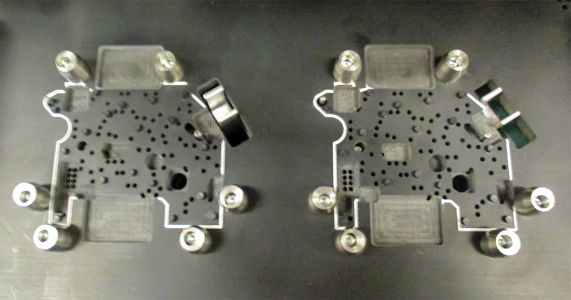

Switch Activation
Switch Activation provides the essential mechanical and electrical triggers required to secure, power, and initiate the testing of a PCBA within a functional or in-circuit environment.
Test Fixture Switch Activation & Interaction
Switch activation is the core mechanism used to trigger and secure a PCBA during functional (FCT) or in-circuit (ICT) testing. These systems act as a safety gate, ensuring the Device Under Test (DUT) is perfectly seated against the pogo pins and electrically connected before any power or test sequences initiate.
Actuation and Interaction Methods
Fixture engagement is typically achieved through Mechanical Handles or Pneumatic Cylinders. These mechanisms force the board against the test probes while simultaneously triggering limit switches or Hall-effect sensors to confirm a safe, closed state.
For testing that requires live interaction with the board, specialized mechanical tools called "Tweakers" are built into the fixture lid. These allow operators to manually press buttons, flip DIP switches, or adjust potentiometers without opening the fixture. In high-volume or fully automated environments, these manual interactions are often replaced by pneumatic or solenoid actuators for autonomous operation.
Technical Hardware Selection
The choice of switch hardware is usually determined by the expected production volume and cycle life:
- Standard End-Stop Switches: The reliable industry standard for general-purpose detection, featuring dual Normally Open/Normally Closed contacts.
- Switch Probes: A cost-effective alternative that utilizes the existing probe infrastructure to create an electrical short when the lid is closed.
- Inductive Switches: Recommended for high-volume lines exceeding 100,000 cycles. Because they use electromagnetic detection instead of physical contact, they eliminate mechanical wear and "contact bounce," making them ideal for high-speed shop floors.
Advanced Applications
Beyond simple start-triggers, these switches manage critical logic such as Power Control to prevent arcing, Mode Selection for flash programming, and Dual-Stage Testing. In dual-stage setups, sensors detect specific press heights to distinguish between short and long probes, allowing the system to switch between ICT and FCT methodologies in a single cycle.


Popular Switch Types
End-Stop Switches
These are standard switches featuring both dual Normally Closed (NC) and Normally Open (NO) contacts. They offer versatility in the interpretation of fixture state by the test system. Generally, JST XHP-3 connectors with 18-inch cables are utilized for connecting to test instrumentation.
Connections
- S: Common
- G: Normally Closed
- V: Normally OpenSwitch Probes (Probe Switches)
An economical approach utilizing the current probe infrastructure. Two test probes situated on the probe plate make contact with a conductive shorting plate affixed to the pressure plate, thereby establishing a detectable electrical short circuit upon the closure of the fixture.
Advantages
- No extra switch hardware necessary
- Straightforward electrical detection
- Inexpensiven
Considerations
- Depends on the quality of probe contact
- Might necessitate specific probe positions
Inductive Switches
Electromagnetic detection that operates without physical contact. The switch detects a metallic target on the moving plate without experiencing mechanical wear.
Benefits
- Millions of cycles without any mechanical wear
- No contact bounce or debounce is necessary
- Sealed design suitable for harsh environments
An economical approach utilizing the current probe infrastructure. Two test probes situated on the probe plate make contact with a conductive shorting plate affixed to the pressure plate, thereby establishing a detectable electrical short circuit upon the closure of the fixture.
Requirements
- Appropriate target material (typically ferrous metal)
- Calibrated distance between the switch and the target
- Compatible mounting configuration
- Recommended for high-volume production surpassing 100,000 cycles
Stroke Switches
Similar to end-stop switches, stroke switches are engineered for extended cycle life and rigorous applications. They come with a range of actuation force options to align with fixture mechanics.
Utilize stroke switches when the number of cycles is expected to surpass the ratings of standard end-stop switches or when a consistent actuation force is essential.
Safety Switches
Improved security features equipped with interlock mechanisms to avert unintentional opening of fixtures during testing. Comply with safety standards in production environments to ensure operator protection.
Employ safety switches when:
- Appropriate target material (typically ferrous metal)
- Calibrated distance between the switch and the target
- Compatible mounting configuration
- Recommended for high-volume production surpassing 100,000 cycles
Fixture Integration Best Practices
- Ensure operational verification prior to production - Test the switch functionality during the commissioning of the fixture.
- Utilize NC contacts for safety - Implement a fail-safe design for critical applications.
- Consider inductive options for high volume - Prevent mechanical wear in production fixtures.
- Adhere to inspection schedules - Regularly verify switch operation.
- Maintain consistent wiring - Standardize switch wiring across fixtures to enhance maintainability.
Mechanical & Pneumatic Side Access